
Hans Rosling did more than most to bring social statistics to a mass audience. Drawing on his experience as a medical doctor and epidemiologist he shared the evidence that in many, many ways the world is getting better. When he was diagnosed with incurable cancer in 2016, working with his son Ola, and daughter Anna, he started writing “Factfulness: Ten reasons we’re wrong about the world – and why things are better than you think”.
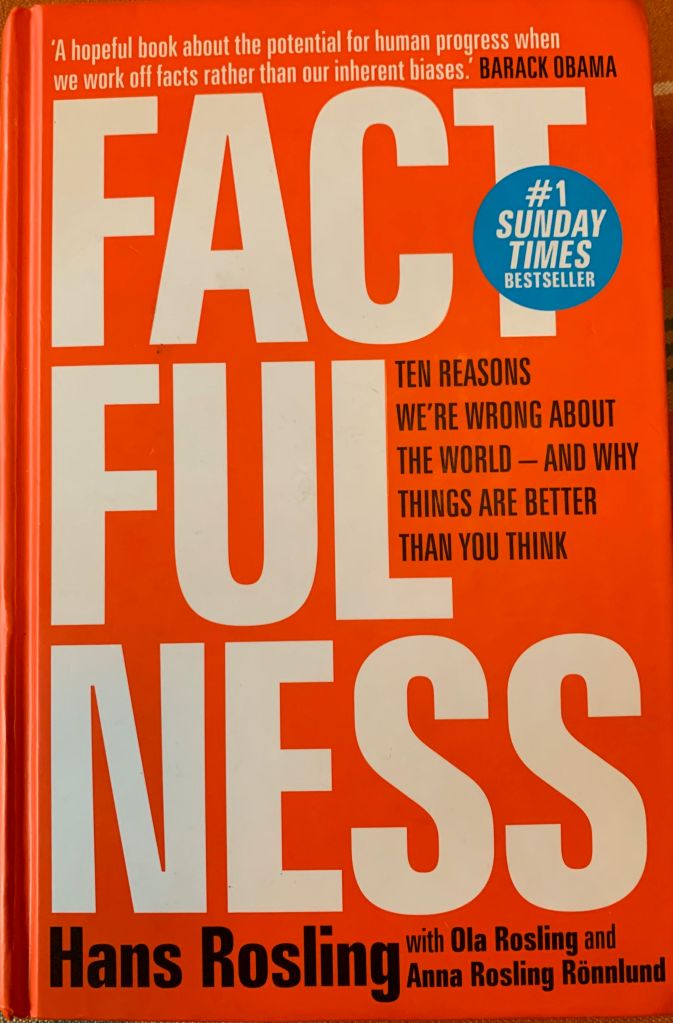
For some time he had been investigating the knowledge of people in different countries, including people who might be thought of as “experts”, about things like life expectancy, education levels , extreme poverty, access to electricity… and discovered that in general their answers were wrong. Very wrong. People erred on the side of pessimism in a big way, and failed to recognise where things had improved.
Far from advocating complacency, Rosling advised that:
- we should be teaching them [children] what life was really like in the past so that they do not mistakenly think that no progress has been made
- we should be teaching them how to hold the two ideas at the same time: that bad things are going on in the world, but that many things are getting better
The key to doing this is to be aware of facts and to seek out data. Newspapers and other media naturally tend to report disasters and bad news. A conscious effort has to be made to see beyond the narratives of despair, to recognise the huge improvements that are going on in many people’s lives.
One particular area of misunderstanding is population growth. Alarmist reports suggest unchecked growth. Whilst it is true the global population will expand for some time to come, fertility rates are falling in nearly every part of the world. Current and future growth is driven mainly by larger numbers of people surviving to middle and old age. Eventually, by the end of the century, growth will stop and the population will fall. https://www.pewresearch.org/fact-tank/2019/06/17/worlds-population-is-projected-to-nearly-stop-growing-by-the-end-of-the-century/
The challenge Rosling sets us is to acknowledge improvements that have been made and work towards further improvements. For anyone who has not yet come across Gapminder here is a link. You can test your own knowledge of key facts, and explore lots of interesting data. https://www.gapminder.org/

 Demographic Insight