
If we look at an age schedule of internal migration, how can we tell is a single outlying data point is signal or noise? We know that 18 year olds are highly likely to migrate, so a peak at that age is to be expected. Similarly, many young people move at age 21, either back to their parental home, or to a different district to take up employment or pursue further study. Boys attending “public schools” (i.e. elite fee-paying boarding schools) may move at age 13. But what if we see a peak at another age? When I came to look at the data for Blackburn with Darwen, a former cotton town in the north west, there appeared to be a peak at age eleven – was this signal or was it noise? There are two ways we might make a decision: first, does it appear repeatedly, year after year? If so, there is a good chance its a real phenomenon. Can we find external evidence that provides a plausible explanation for a peak at that age? Let us look at the out- and in-migration schedules for Blackburn.
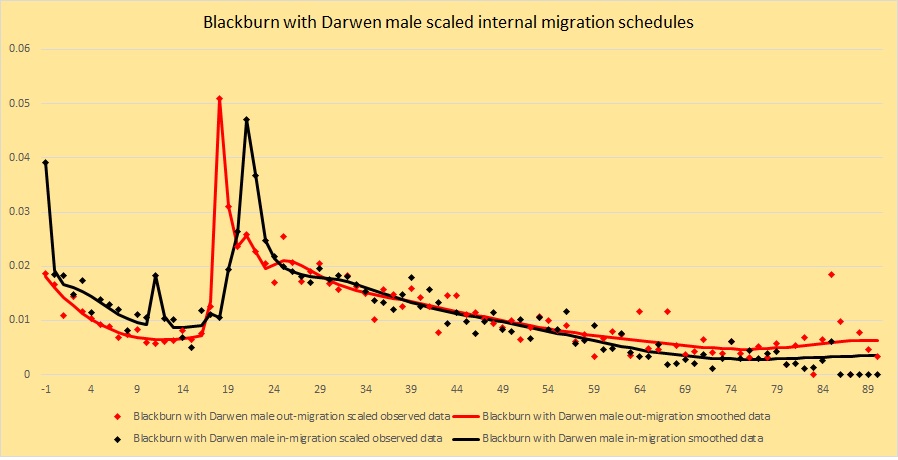
I was not aware of a well known public school in Blackburn, so I conducted a quick Google search on Blackburn… these were the top two results:

So it appears that there is a successful and popular boarding school in Blackburn. A check on the school’s website revealed that pupils are recruited at age 11 into Year 7. http://www.jamiah.co.uk/
This provides a plausible explanation for the eleven year old peak. Therefore it makes sense to include it in the model.

 Demographic Insight