
In an earlier post I explained how the sudden reversal in school pupil numbers got me interested in demography. After what seemed like a couple of decades of falling rolls numbers started rising. As a local authority senior education manager I had been involved in closing and amalgamating schools as they became unviable. To a large extent, our work was about planning for contraction. When it became apparent numbers were rising I wanted to understand more.
I often acquire books by browsing in bookshops – real physical ones. It was at about that time that this caught my eye:

It looked interesting so I took it from the shelf and started reading. The full title was The Age Curve: How to Profit from the Coming Demographic Storm.
It was by an “internationally recognised expert in the field of demography and generational marketing who counsels both Fortune 500 and small businesses across the country.” Clearly American, clearly marketing oriented, but hey, if there was a coming demographic storm I wanted to know about it, be ready for it, and maybe even profit from it. I parted with £13.99 and took it home to read.
The thesis is simple: the American population is divided into “generations” that had different early experiences (war/peace; growth/recession; etc.) and each was a different market segment. What was new was Gronbach’s linking of this to the numbers born (in the US) into each generation. The GI generation (1905 to 1924) was relatively numerous – at least when they were born. They were the ones who fought in WW2. The silent generation (1925 to 1944) was small. They were mostly to young to fight in WW2 – they didn’t have war stories to tell, so they mainly kept quiet. Then there were the baby boomers 1945 – 1964. There were lots of them. They were born in a time of (relative) peace. Their parents were the GI generation. They benefited from post-war growth, and liberalising social attitudes. they still run much of the world. Generation X (1965 to 1984) was much smaller – their parents were the correspondingly small silent generation. Their market clout was not so great, simply because they were few in number. And then Generation Y (1985 – 2004) – the baby boomers kids – another big generation. Gronbach states: “The generational sections vary dramatically in size. This fact makes their consumption habits very predictable. Big ones need more food and bicycles. Little ones will eat and ride less.” This can be linked to preferences for all kinds of consumer products, and can potentially explain why sales of some slump while others boom.
No doubt there is a lot of room for debate around these ideas, including whether these generations really exist in any real sense. But these waves of population may explain the relative and changing balance of sales of Harley Davidsons and Hondas, this or that beverage.
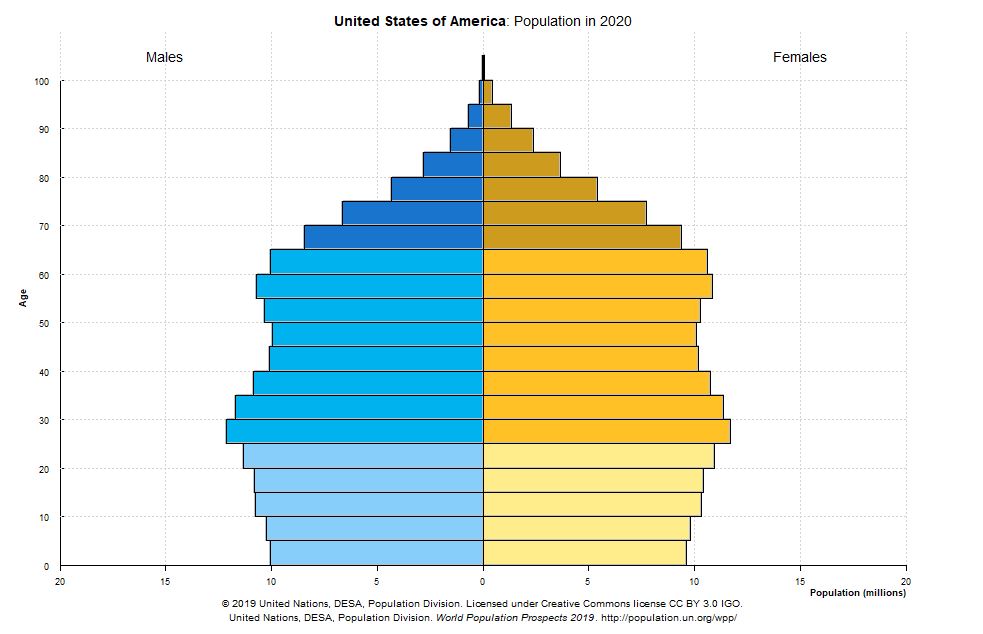
I checked the age profile of births in England and Wales, and the resulting population pyramids. They are not quite the same as the US – but there are similarities as these pyramids taken from the UN website show.

I found Gronbach’s theory interesting, and persuasive – but then he is an internationally recognised marketing expert, so that’s his job. But whether you buy all the generation theory or not, clearly the waves of larger and smaller cohorts will have a big impact on services that are very specific to particular age groups. And nothing is more age specific than schooling: it’s all set out in law -in England and Wales a child becomes of statutory school age the term following their fifth birthday… they can join Reception class the school year before. They take Key Stage 2 tests in Year 6, and in most areas they transfer to secondary school for the start of Year 7, etc..
The UK pyramid shows a large age group at 30-34, with successively smaller age groups down to ages 15-19. That helps to explain that part of my career, the time of falling rolls, when we were having to remove surplus places. The larger size of the younger cohorts explains why we are now having to add places back. (Projections suggest a relatively stable period thereafter – we’ll see.)
Gronbach’s book is now over a decade old, and things have moved on. I would still commend it to those who are interested in generation theory, and an easy introduction to some basic ideas about population change.

 Demographic Insight