Books

The durability and fragility of English local government

In certain respects local government in England is very durable. Some cities or boroughs have charters dating back manmy centuries. Southampton will appoint its 799th mayor next month. Although the geographical definition of Southampton and the powers vested in the mayor, burgesses, corporation, and council of Southampton have changed many times, there is a real continuity. In certain respects local government has a longer history than some aspects of national government.

However in other respects local government arrangements can seem very fragile: its duties and powers are constantly changing, there are frequent restructures and renamings. Indeed, yesterday there were some important changes in several areas. By convention, and to align with the local government financial year, such restructurings take place on 1st April – April Fools Day. The non-metropolitan county of Northamptonshire and all the district councils within it were abolished yesterday. Two new unitary councils were formed: North Northamptonshire, comprising the former districts of Corby, East Northamptonshire, Kettering and Wellingborough; and West Northamptonshire, comprising the former districts of Daventry, Northampton and South Northamptonshire. This followed a major financial crisis at Conservative-led Northamptonshire County Council.

Other areas have been reorganised recently: Dorset, Somerset and Suffolk in 2019, and Buckinghamshire in 2020. These have tended to reduce the number of councils, and often to replace a two-tier system with a single-tier unitary system in which all local services and powers are held by a single council. Sometimes council’s change their name: for example Shepway became Folkestone and Hythe. Usually this is to replace an obscure name with one using more familiar geographical features: such as the principal town(s).

Whilst there is often a good reason for such changes, it would not be true to say that consistent principles have been applied over the past 25 years. Constant change tends to create the impression that all local government arrangements are provisional and can be changed on a whim. Some stability and a clear definition of the constitutional role of of local government in England would be welcome….. in my opinion.

Books

What got me interested…

In an earlier post I explained how the sudden reversal in school pupil numbers got me interested in demography. After what seemed like a couple of decades of falling rolls numbers started rising. As a local authority senior education manager I had been involved in closing and amalgamating schools as they became unviable. To a large extent, our work was about planning for contraction. When it became apparent numbers were rising I wanted to understand more.

I often acquire books by browsing in bookshops – real physical ones. It was at about that time that this caught my eye:

Kenneth W Gronbach (2008) The Age Curve

It looked interesting so I took it from the shelf and started reading. The full title was The Age Curve: How to Profit from the Coming Demographic Storm.

It was by an “internationally recognised expert in the field of demography and generational marketing who counsels both Fortune 500 and small businesses across the country.” Clearly American, clearly marketing oriented, but hey, if there was a coming demographic storm I wanted to know about it, be ready for it, and maybe even profit from it. I parted with £13.99 and took it home to read.

The thesis is simple: the American population is divided into “generations” that had different early experiences (war/peace; growth/recession; etc.) and each was a different market segment. What was new was Gronbach’s linking of this to the numbers born (in the US) into each generation. The GI generation (1905 to 1924) was relatively numerous – at least when they were born. They were the ones who fought in WW2. The silent generation (1925 to 1944) was small. They were mostly to young to fight in WW2 – they didn’t have war stories to tell, so they mainly kept quiet. Then there were the baby boomers 1945 – 1964. There were lots of them. They were born in a time of (relative) peace. Their parents were the GI generation. They benefited from post-war growth, and liberalising social attitudes. they still run much of the world. Generation X (1965 to 1984) was much smaller – their parents were the correspondingly small silent generation. Their market clout was not so great, simply because they were few in number. And then Generation Y (1985 – 2004) – the baby boomers kids – another big generation. Gronbach states: “The generational sections vary dramatically in size. This fact makes their consumption habits very predictable. Big ones need more food and bicycles. Little ones will eat and ride less.” This can be linked to preferences for all kinds of consumer products, and can potentially explain why sales of some slump while others boom.

No doubt there is a lot of room for debate around these ideas, including whether these generations really exist in any real sense. But these waves of population may explain the relative and changing balance of sales of Harley Davidsons and Hondas, this or that beverage.

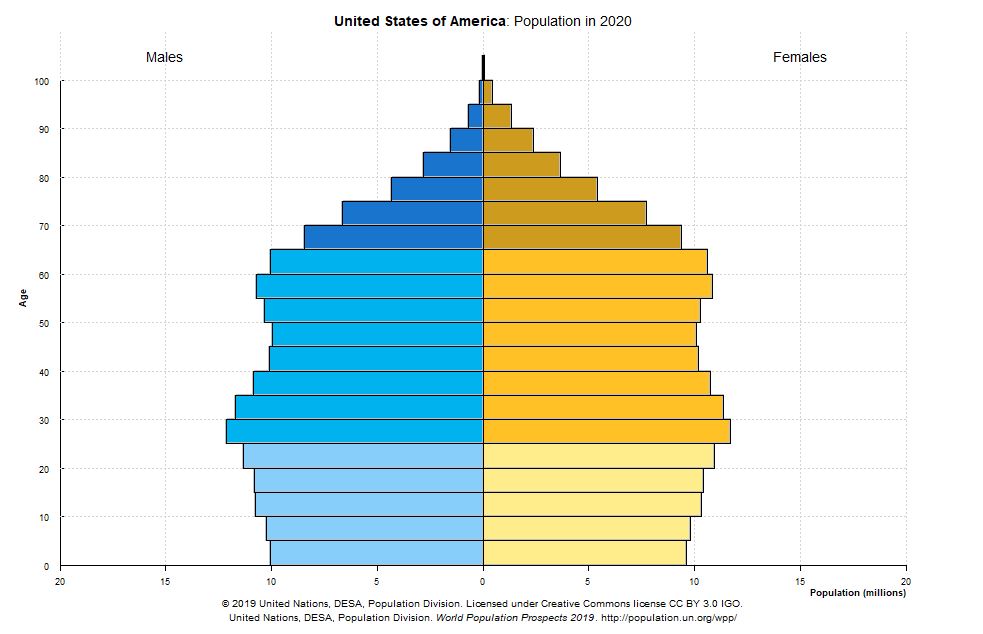
I checked the age profile of births in England and Wales, and the resulting population pyramids. They are not quite the same as the US – but there are similarities as these pyramids taken from the UN website show.

I found Gronbach’s theory interesting, and persuasive – but then he is an internationally recognised marketing expert, so that’s his job. But whether you buy all the generation theory or not, clearly the waves of larger and smaller cohorts will have a big impact on services that are very specific to particular age groups. And nothing is more age specific than schooling: it’s all set out in law -in England and Wales a child becomes of statutory school age the term following their fifth birthday… they can join Reception class the school year before. They take Key Stage 2 tests in Year 6, and in most areas they transfer to secondary school for the start of Year 7, etc..

The UK pyramid shows a large age group at 30-34, with successively smaller age groups down to ages 15-19. That helps to explain that part of my career, the time of falling rolls, when we were having to remove surplus places. The larger size of the younger cohorts explains why we are now having to add places back. (Projections suggest a relatively stable period thereafter – we’ll see.)

Gronbach’s book is now over a decade old, and things have moved on. I would still commend it to those who are interested in generation theory, and an easy introduction to some basic ideas about population change.

Books

Factfulness

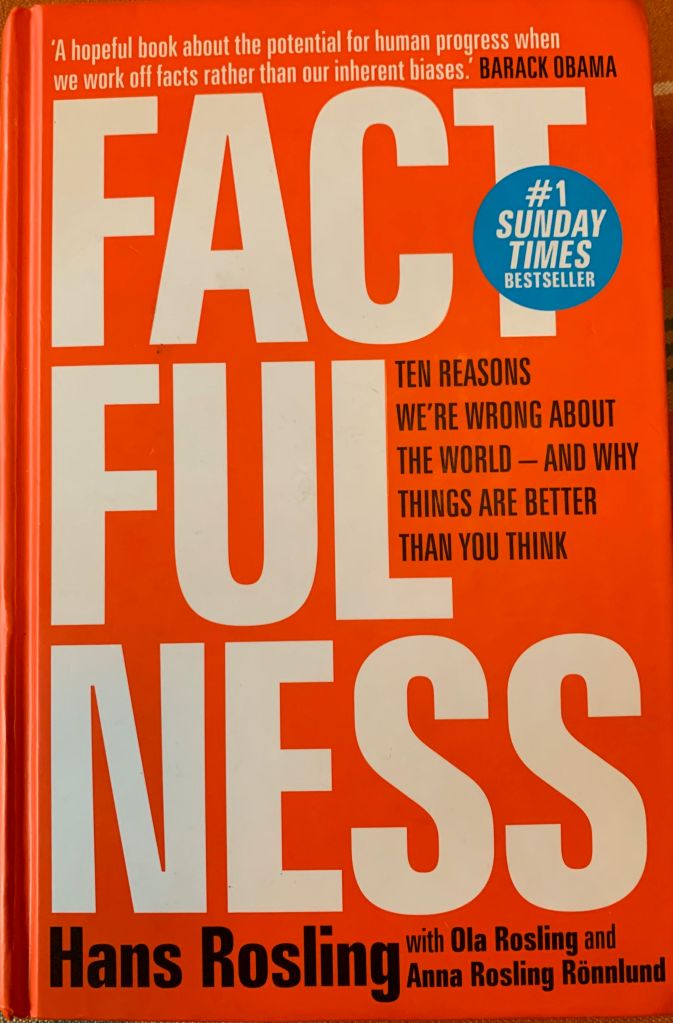
Hans Rosling did more than most to bring social statistics to a mass audience. Drawing on his experience as a medical doctor and epidemiologist he shared the evidence that in many, many ways the world is getting better. When he was diagnosed with incurable cancer in 2016, working with his son Ola, and daughter Anna, he started writing “Factfulness: Ten reasons we’re wrong about the world – and why things are better than you think”.

For some time he had been investigating the knowledge of people in different countries, including people who might be thought of as “experts”, about things like life expectancy, education levels , extreme poverty, access to electricity… and discovered that in general their answers were wrong. Very wrong. People erred on the side of pessimism in a big way, and failed to recognise where things had improved.

Far from advocating complacency, Rosling advised that:

  • we should be teaching them [children] what life was really like in the past so that they do not mistakenly think that no progress has been made
  • we should be teaching them how to hold the two ideas at the same time: that bad things are going on in the world, but that many things are getting better

The key to doing this is to be aware of facts and to seek out data. Newspapers and other media naturally tend to report disasters and bad news. A conscious effort has to be made to see beyond the narratives of despair, to recognise the huge improvements that are going on in many people’s lives.

One particular area of misunderstanding is population growth. Alarmist reports suggest unchecked growth. Whilst it is true the global population will expand for some time to come, fertility rates are falling in nearly every part of the world. Current and future growth is driven mainly by larger numbers of people surviving to middle and old age. Eventually, by the end of the century, growth will stop and the population will fall. https://www.pewresearch.org/fact-tank/2019/06/17/worlds-population-is-projected-to-nearly-stop-growing-by-the-end-of-the-century/

The challenge Rosling sets us is to acknowledge improvements that have been made and work towards further improvements. For anyone who has not yet come across Gapminder here is a link. You can test your own knowledge of key facts, and explore lots of interesting data. https://www.gapminder.org/

Books

Keywords: demography/demographics

I came to demography late in life.  My first interest was in English – literature and language – and cultural studies. I knew that was what I wanted to study from a young age, and I was lucky enough to be offered a place at Jesus College Cambridge.  One of my teachers there was Professor Raymond Williams.  He was the son of a railwayman, grew up in the Welsh borders, had a strong affinity for working class life and values, studied at Cambridge, taught for Oxford university’s ‘delegation for extra-mural studies’ closely associated with the Workers’ Educational Association, before having an academic career in Cambridge.  He managed to bridge the gap between traditional Cambridge literary criticism, Marxist approaches, and some of the modern theories emanating from continental Europe. He was also, in my experience, a very good teacher, approachable and supportive.

One of his books was Keywords: A vocabulary of culture and society (1976), which explored, explained, deconstructed important words in the field of cultural studies. Words such as culture, class, industry, intellectual, society featured, starting with their derivation, whether from latin, greek, or old norse.  The layers of meaning, sometimes contested, sometimes contradictory, were revealed.  The effect of the whole book was to understand the vocabulary of Williams’ intellectual model, and (from the perspective of a nineteen year old undergraduate) to acquire instant erudition.

My copy of ‘Keywords’ purchased 1977 as a first year undergraduate

So what of “demography”? I start as Williams did with the Oxford English Dictionary, which states that the origin of the word was a borrowing from Greek with an English element.  Its primary definition is given as: “the study of human populations, especially the study of statistics, such as numbers of births and deaths, the incidence of disease, or rates of migration, which illustrate the changing size or composition of populations over time.”

δεμοσ [demos] + GRAPHY an abstract noun of action or function, the first cited example of its use was as a conscious neologism from the Transactions of the Provincial Medical and Surgical Association in 1834, “were it desirable to invent a new name, perhaps Medical Demography would be more appropriate, when applied to a thickly-peopled district”. The next example from the Library of Universal Knowledge in 1880 also focuses on the medical dimension: “the statistics of health and disease”.  These early examples, and the definition they support continue to describe accurately a core meaning of demography – its focus on births, deaths, migration, population size and composition, its close relationship with statistics, etc..

A second definition is given as “the composition of a particular human population”.  First example from the Gentleman’s Magazine in 1837, “These inscriptions throw light on the Demography of Attica”. Second example, from Norway: Official publication for the Paris Exhibition in 1900, “good and abundant material for the study of the demography of our country.”

These two definitions, closely linked, echo two distinct meanings of statistics (a scientific methodology for the analysis of data, and the data itself).  So “demography” is a scientific discipline with its own methods and devices, such as life tables, population pyramids, and agreed formulae for calculating key summary measures.  It is also used to describe the population itself – “Germany has an ageing population.” “Fertility rates in sub-Saharan Africa remain high.” “University cities have high in- and out- migration of young people.”

A further definition extends the meaning of demography to the analysis of plant and animal populations – somewhat in contradition of the Greek demos – however the methodologies are clearly transferable to any population where members come into existence, move about, and ultimately die.

Let us move to “demographic”… it clearly shares the same origin, and is often used as the adjective associated with “demography” – as in “demographic methods”, but it also has a somewhat distinct meaning in relation to the description of sub-populations.  The OED locates this latter meaning originating in the USA as a noun – “a particular section of a population, typically defined in terms of factors such as age, income, ethnic origin, etc., especially regarded as a target audience for broadcasting, advertising, or marketing.”  An example of this use is cited from Billboard in 1972 “in trying to project a younger demographic, they wind up playing the Osmonds, the Partridge Family.  What you see at that point is a mass exodus of listeners.”  Or in Vancouver in 1992: “The new Chinese demographic: wealthy, sophisticated middle class expats who still insist on the quality they enjoyed in Hong Kong.”

So there are two broad groups of meanings “demography” as a science, focussing on fertility, mortality and migration – with various detailed methodologies, often close to national or international statistical agencies, supporting development activities, measuring the success of health interventions, etc. and “demographics” as a noun – a marketing concept intended to subset a population into groups who can be sold differend goods and services, advertised through different media.

My personal observation is that “demography” – as a science – is not well understood by non-specialists, even well educated ones; but “marketing demographics” is  quite a familiar concept to many people.  Perhaps those of us who are more affiliated to “demography” need to do more to promulgate our science and its headline findings?

Views and comments would be welcome.

The work of Raymond Williams on “keywords” is celebrated and preserved on the Keywords website, jointly maintained by Jesus College Cambridge and the University of Pittsburgh: https://keywords.pitt.edu/williams_keywords.html