Internal migration

The challenges of modelling internal migration in England and Wales: Part 1 – Single Year Peaks

People in England and Wales move around quite a lot, which makes them hard to count, and makes it hard to forecast how many will be where in the future. The age at which people are most likely to migrate between local authority districts is 18 – by quite a big margin. 18 is the age at which individuals acquire most of their adult rights and responsibilities. It is also the most common age for enrolment into university for undergraduate degrees. Whilst some young people are able to continue to live in their family home and travel to a local institution, many choose to move away from home. The social opportunities of going to university, as well as the educational opportunities, are strong motivators. It is, for most, a partial transition. Many students will return “home” for the holidays, and maybe some weekends. They will often retain a circle of friends in their home town, they may keep their bedroom at home, and still have a sense of ownership of their pet dog, which is now walked by their middle aged parents. Not so long ago it was statistical convention that they be recorded as resident at their parents’ home, but for some time now the convention has been to regard them as resident in their university district – clearly in respect of some public services they have an impact in both places.

Whilst not all undergraduates start their studies at 18, the large majority do – hence the visible out-peak at that age in every local authority district. There is, of course, a corresponding in-peak in university districts. In districts dominated by higher education institutions, this is particularly marked. When I began my investigations I was surprised to find in-peaks in districts that I had not associated with universities: Oadby and Wigston (a suburban satellite of Leicester), Vale of White Horse (a rural and suburban district west of Oxford), and Broxstowe (an area of small mining towns and villages west of Nottingham). On investigation theses all proved to be districts where student halls of residence attached to the neighbouring university cities were located.

A typical residential trajectory for a student in England and Wales is from home to hall of residence at age eighteen, then to private rented accommodation the following year. This provides a gradual transition for the student (and the anxious parents). The hall of residence is likely to benefit from some supervision by the university and students’ union. It often provides a catering service, and deals with aspects of cleaning, repairs, etc.. Students usually live in single rooms within flats where there is some communal space including a kitchen. So the transition from being a dependent minor, to a (somewhat) independent adult is eased. By their second year students often move to a different type of accommodation. Sometimes this can be private sector student apartments (not dissimilar to halls of residence), or the “student house” – a normal residential house, often a Victorian terrace house, or a 1930s semi, where students live together in small groups, with very little supervision and much greater independence, both from parental and university control. Typically these student house areas are more urban than the halls of residence areas – so from leafy Oadby and Wigston to Leicester, from Vale of White Horse to Oxford city, from Broxstowe to Nottingham. This can produce a strong single year peak of migration as students move from one district to another – even if it is only a mile or two. (The resulting schedules of migration between Leicester and Oadby and Wigston can be seen in my post of 1st January 2020 “A Year of exciting demography ahead”.)

Most districts show an in-peak at 21 – likely to be graduates returning “home” after university, plus graduates taking up employment. The following example is from Harrogate, an attractive spa town in North Yorkshire.
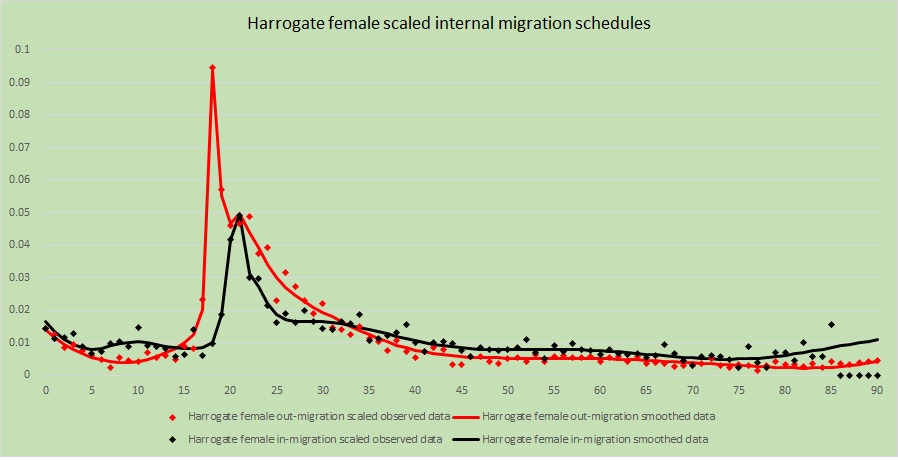
Note the out-peak at 18 and the in-peak at 21

The English and Welsh education systems are strongly structured by age. Children are obliged to be in full time education from the term after their fifth birthday. For most this means school, and it is usual to start in a “reception” class the year before as a four year old. Schools and local education authorities tend to be resistant to educating children outside their chronological age group, and will often only do so with the support of a (hard to obtain) recommendation from an educational psychologist. This means that children move through the school system in age cohorts, transferring from primary to secondary school the September after their eleventh birthday, and moving from statutory secondary education to slightly less statutory “sixth form” or further education at 16. Nearly all young people finish their schooling in the year of their eighteenth birthday, and for those that are going to move on to higher education, 18 is the most likely age to make that transition.

For the modeller of age schedules of migration this presents as challenge: we often want to remove noise – random age to age fluctuations in migration levels – but these sharp single year peaks are not noise, but signal. Childhood migration extends over several years, and can often be modelled as a negative exponential curve, and retirement migration is a phenomenon that can be observed as a shallow hump over the years of later middle age and early old age. However the education driven migration curves often focus on just a single year. Another phenomenon in England which applies to a small number of districts is the “public school peak” observed at age 13 amongst boys.

A public school in England is not a state school, but rather a fee-paying independent school, often established many hundreds of years ago. The most famous include Eton, Harrow and Winchester. The small district of Rutland, England’s third smallest district by population (just below 40,000) has a public school in both of its towns: Oakham and Uppingham.

A marked in-migration peak can be seen at age 13 as boys arrive at the two public schools. The height of the out-migration peak at 18 is likely to be enhanced by the two schools, as their pupils go to university, or return to their family home – either way almost certainly leaving Rutland. Modelling these peaks is clearly essential.

So, in conclusion, migration schedules in England and Wales requires modelling phenomena that extend over a range of age groups, and single year peaks, most often associated with educational institutions where there is a residential component. It would certainly be a mistake to regard these peaks as “noise” to be smoothed out. They are an important part of the signal.
demography

A year of exciting demography ahead!

Hello! I’m back after a long break, and looking forward to a year of exciting demography. My plans include kickstarting my research into internal migration in England and Wales. The way people move around the country, at different ages, is a fascinating topic which can tell us a lot about people and places. It is also an essential component of population change, and hence of population forecasting. It is forecasting which is my central interest, and in the course of 2020 I hope to move from modelling internal migration towards integrating it into a new forecasting model. I will be posting lots of findings and data on my Twitter account @andrewuniv.

I am also looking forward to attending the European Population Conference in Padova in June. It will be good to meet up with other demographers, and also to see a great European city. I’ll be there for a few days either side of the conference. It’s only half an hour by train to Venice, so I’m sure I’ll make at least one day trip.

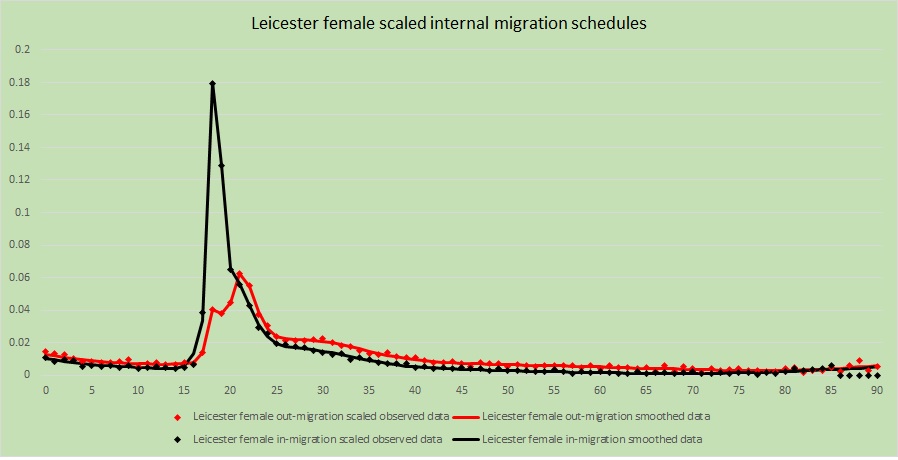
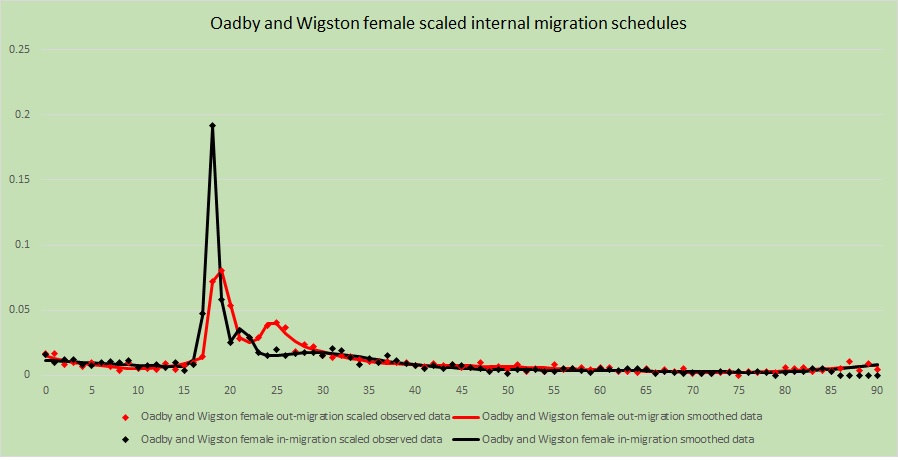
The British Society of Population Studies is holding its annual conference in Leicester… or is it Oadby and Wigston? The University of Leicester venue, Stamford Court is on the halls of residence complex which lies just outside the city, in the neighbouring borough of Oadby and Wigston. This leads to some interesting migration patterns… lots of 18 year olds come in to Oadby and Wigston, only to move out to Leicester at 19. Halls of residence as first years, private rented accommodation as second years. There are one or two other similar pairings: Reading and Wokingham; Nottingham and Broxstowe for example.

Note strong in migration at 18 and out migration at 21: typical of university cities

Note the high outmigration at 18 – off to university, and at 19 off to Leicester after a year in halls

Meanwhile I will continue to work for local authorities part time, particularly on school place planning and its consequences – new school buildings. And my practical experiments in gerontology – looking after an aged parent will take up my weekends.

Have a great 2020! Andrew

School place planning

New schools: rising numbers in England

School place planning is often cited as one of the top reasons for making local population projections – or forecasts – so what’s happening to the school population in England now?

After a considerable time when schools were generally getting smaller, and all the talk was of “falling rolls” and school closures, the last decade has seen growth. This affected primary schools first (pupils aged 5-10) and more recently has started to impact on secondary schools (pupils aged 11-15). It won’t be long before it affects (vocational) further education colleges and (academic) sixth form colleges (students aged 16+).

Rising rolls don’t necessarily mean new schools. There may be some slack in the system which will fill up first, and local authorities may choose to expand existing schools rather than create new ones. Thre following is a round-up of news this week that illuminates current developments in England.

Residents of Chilmington Green in Ashford Kent are complaining about the design of the new school in their estate:

https://www.kentonline.co.uk/ashford/news/new-school-looks-like-detention-centre-212638/

“members of Ashford Borough Council’s planning committee have criticised its appearance, with one saying the look of the site reminds them of a “detention centre”.

“When built, the primary school will be one of four serving the 5,750-home development, but frustrated councillors say the structure is “overbearing”…”

This illustrates one of the difficulties of planning in England: the two tier system of local government in non-metropolitan counties means that the county council is responsible for planning school places, but the district council is responsible for town and country planning. The story also illustrates the huge scale of new housing developments in parts of the affluent south east of England. Ashford is in many respects a workaday town, closely connected to the channel tunnel. Ashford Internation is the last station in England before the tunnel disappears under the sea at Folkestone. I suspect the two councils will resolve their differences, and the school will be built. The housing will not be very attractive if parents can’t find a school place for their children.

A similar story is reported in Cambridge. The fenland university city is no longer just a higher education version of Hogwarts… it is one of the most thriving industrial centres in England. Little or no metal is bashed there though…. Cambridge’s industry is hi-tech: semi-conductors and pharmaceuticals. As in Kent, the thriving economy demands new houses, which in turn means new schools. And as in Kent, there are arguments between the tiers of local government about the appearance of the new building: https://www.cambridge-news.co.uk/news/cambridge-news/cambridge-schools-marshal-group-wing-16942509

In nearby Norfolk there is some controversy about the proposed new Alderman Swindell school for pupils with social, emotional and mental health needs in Great Yarmouth. Such schools are often viewed with some caution by local residents. In this case the controversy seems to be around the closure of the former Alderman Swindell primary school. We’ll see how this one develops. https://www.edp24.co.uk/news/education/first-look-at-new-school-on-alderman-swindell-great-yarmouth-site-1-6289422

In the town of my birth, Watford, a new primary school is planned: four storeys high with a playground on the roof. Just outside London, but within the M25 London orbital motorway, Watford is less than 20 minutes from central London by train, and is highly popular with London workers who want a little more space, for a little less money than is available in the big city. I am fascinated by the proposed design of this school, which will presumably have a very small footprint. My own primary school is only a mile away. And in the 1960s still had the remnants of a farm tucked away around the back. Yes, all this was fields when I was a boy. https://www.watfordobserver.co.uk/news/17913456.gp-surgery-cards-first-look-new-school-st-albans-road-site/

A field in Rempstone Road, East Leake in Nottinghamshire is due to be turned into a large housing estate with a school. The county council is clearly keen to be on the front foot to be sure that the school is ready for the population expected to arrive in the new developments in the village. https://www.nottinghampost.com/news/local-news/primary-school-built-notts-village-3342745

Finally, some happy pupils in Gloucester, who think their new primary school building is “epic”. As is often the case, once the thing is done everybody quite likes it. https://www.gloucestershirelive.co.uk/news/gloucester-news/inside-new-65m-primary-school-3333942

Let’s see what happens next week!

Books

Factfulness

Hans Rosling did more than most to bring social statistics to a mass audience. Drawing on his experience as a medical doctor and epidemiologist he shared the evidence that in many, many ways the world is getting better. When he was diagnosed with incurable cancer in 2016, working with his son Ola, and daughter Anna, he started writing “Factfulness: Ten reasons we’re wrong about the world – and why things are better than you think”.

For some time he had been investigating the knowledge of people in different countries, including people who might be thought of as “experts”, about things like life expectancy, education levels , extreme poverty, access to electricity… and discovered that in general their answers were wrong. Very wrong. People erred on the side of pessimism in a big way, and failed to recognise where things had improved.

Far from advocating complacency, Rosling advised that:

  • we should be teaching them [children] what life was really like in the past so that they do not mistakenly think that no progress has been made
  • we should be teaching them how to hold the two ideas at the same time: that bad things are going on in the world, but that many things are getting better

The key to doing this is to be aware of facts and to seek out data. Newspapers and other media naturally tend to report disasters and bad news. A conscious effort has to be made to see beyond the narratives of despair, to recognise the huge improvements that are going on in many people’s lives.

One particular area of misunderstanding is population growth. Alarmist reports suggest unchecked growth. Whilst it is true the global population will expand for some time to come, fertility rates are falling in nearly every part of the world. Current and future growth is driven mainly by larger numbers of people surviving to middle and old age. Eventually, by the end of the century, growth will stop and the population will fall. https://www.pewresearch.org/fact-tank/2019/06/17/worlds-population-is-projected-to-nearly-stop-growing-by-the-end-of-the-century/

The challenge Rosling sets us is to acknowledge improvements that have been made and work towards further improvements. For anyone who has not yet come across Gapminder here is a link. You can test your own knowledge of key facts, and explore lots of interesting data. https://www.gapminder.org/

Gerontology

Practical gerontology

Hello! I have woken up the blog again after a very long break.  I have been engaged in some practical gerontology since my last post.  In brief, my aged father had what should have been a simple investigative medical procedure last autumn under general anaesthetic.  Instead of the day trip to hospital that we had expected he was in for several days, then prematurely discharged, then readmitted, then prematurely discharged again, as a result of which both he and my mother had to be found a care home.  Although the one we found was pretty good, and very close to their own home, it proved a difficult transition to manage.  We were able to make arrangements for my father to move back to the house in the new year, and had hoped my mother would follow, but sadly she had a couple of serious infections in the home, was admitted to hospital and died a few weeks later of pneumonia and underlying dementia. I don’t intend this to be a personal account so I’ll leave the narrative there.

What the story made clear to me is just how hard care of the elderly is.  My parents had plenty of resources, two adult children able to help, many friends and relations, and it was still hard to get things sorted out and find satisfactory solutions.  The NHS will only deal with medical problems, and local government has very little resources to support with social problems: even providing useful advice is difficult, or information about where to find paid-for services.

We know that social care for the elderly is a major challenge for policy makers in the UK and most developed countries.  The cost of providing support whether social or medical, is substantial.  The numbers of elderly people is growing year by year.  If affluent, well educated professional people struggle to find what they need (my mother was a psychiatric social worker and my father a commercial accountant), then the challenge for poor people is even greater.

We have been hearing for the last two or three years that improvements in life expectancy have stalled, or gone into reverse.  Much of the decline seems to be around higher mortality at advanced age – so mortality rates for the young and middle aged are much as before, but those for people in their eighties and above are not so good.  My own observation suggests why this might be… hospitals are keen to discharge people as quickly as possible, and if discharged to their own homes they are essentially expected to fend for themselves.  The quality of the clinical procedures might be fine, but the elderly need quite a lot of recovery time if they are to get back to their previous health status.  More resources are needed… but better use of the resources currently available would help.  And in the UK the buck passing between the NHS and local government needs to be sorted out.  It’s not about providing everything free of charge, but making sure there are systems, whether state or privately funded, that can help the frail elderly live better, healthier lives.